
The Complete Guide to Metal Allergies for Wind Instrument Players | Causes, Symptoms and Mouthpiece Solutions

'If I develop a metal allergy, does that mean I can no longer use my current mouthpiece?' — For brass players, this is a rather pressing issue.
To put it simply, medical literature does report cases of metal allergies and contact dermatitis arising in connection with playing brass instruments. However, redness, itching, swelling or a stinging sensation on the lips are not necessarily all caused by a metal allergy. Similar symptoms can also be caused by irritative inflammation resulting from pressure, friction, dryness, saliva or cleaning agents, so it is important not to jump to conclusions about the cause.
In this article, drawing on the perspective of wind instrument players and referring to medical and dental literature, we will outline the understanding of metal allergies, their relationship with mouthpieces, diagnostic tests and practical countermeasures.
1. Can metal allergies occur in wind instrument players?
It is possible. When playing an instrument, the skin, lips and oral mucosa come into repeated contact with the instrument or mouthpiece in the same area over long periods of time. A review summarising skin problems among musicians reports cases of allergic contact dermatitis caused by substances such as nickel in brass instrument players, including trumpet players.
Furthermore, there are case reports of cheilitis caused by nickel allergy in trumpet players, including a report from Japan titled 'Nickel allergy in a trumpet player'. In short, it has been medically confirmed that, at the very least, 'the link between brass instruments and metal allergies is not an urban myth'.

2. In Japan, there have also been reports of cases thought to have been caused by mouthpieces.
In 2021, a research group including Tokushima University reported a case of oral mucositis thought to be caused by a metal allergy to a tuba mouthpiece. The patient developed swollen gums and inflammation in the mouth after taking up playing in a brass band, and the condition did not improve with standard oral hygiene advice alone.
Subsequently, the symptoms improved significantly after the instrument and mouthpiece were replaced. Extensive flaking of the plating was observed on the old mouthpiece, and metal composition analysis and patch tests suggested that a reaction to chromium may have been involved.
Of course, one case alone is not sufficient to conclude that 'flaking plating will inevitably cause an allergy'. However, this is a very important report, demonstrating the need to consider the temporal relationship between playing and the onset of symptoms, as well as the materials in contact with the mucosa and the condition of their surfaces.

3. What exactly is a metal allergy?
The basic understanding is that, rather than the metal itself acting as an 'allergen', metal ions leach out into the environment—such as through sweat or saliva—and bind with proteins in the body, triggering a reaction from the immune system. Most cases of contact allergy are classified as delayed-type (Type IV) reactions.
In cases of contact allergy affecting the oral cavity and the area around the mouth, a wide range of symptoms have been reported, including cheilitis, stomatitis, gingivitis, perioral dermatitis, a burning sensation and lichen-like reactions. However, as similar symptoms can also arise from non-allergic irritant reactions, it is considered difficult to distinguish between the two based on appearance alone.

4. What is the mouthpiece made of?
Brass is the most common base material for brass instrument mouthpieces. Yamaha also explains in its official documentation that brass is generally used for brass instrument mouthpieces. Some products feature surface finishes such as silver plating or gold plating applied over this base material.
In other words, it is not accurate to assume that the entire mouthpiece is made of silver simply by looking at the 'silver-coloured surface' that the player comes into contact with. It is necessary to consider the type of surface treatment, the condition of the coating, and the base material beneath it.

5. Are silver-plated and gold-plated items absolutely safe?
It cannot be stated categorically that 'gold is absolutely safe' or 'silver is absolutely safe'. Whilst nickel, cobalt and chromium are well-known causes of contact allergies, positive reactions to materials such as gold and palladium have also been reported.
Furthermore, if the surface treatment wears away or becomes damaged, the underlying layer or base material may be exposed. It is therefore important not to judge safety or risk based on the name of a single material alone, but to consider the following factors together: 'what you are allergic to', 'which materials you are actually in contact with', and 'the condition of the surface'.

6. If symptoms appear, what should you check first?
Record the date and time of your performance and the time when symptoms appeared
Check where on your lips the symptoms appear
Compare whether the symptoms occur only with a specific mouthpiece
Check for any wear, discolouration, scratches or peeling of the plating
Check for symptoms in areas other than the mouth, such as the hands or neck, which come into contact with the instrument itself
At the same time, review other potential irritants such as lip balm, detergents, disinfectants and cosmetics
These records will also be useful when consulting a dermatologist or allergist. Rather than simply stating 'it itches when I play', providing details such as 'a few hours after using this mouthpiece for 30 minutes, redness appears in the area where the rim comes into contact with my lips' makes it easier to pinpoint the cause.

7. How are metal allergies tested?
Patch tests are generally regarded as a key diagnostic tool when investigating metal contact allergies. However, it cannot simply be concluded that 'a positive patch test result means that metal is the cause of the current symptoms'.
A systematic review and meta-analysis of dental metal allergies published in 2026 also highlighted significant variability between studies and emphasised the importance of confirming the clinical association between symptoms and positive test results. In other words, a diagnosis must be made by considering the test results in conjunction with actual exposure and symptoms.
UPMAKE does not provide medical diagnoses. If you experience severe swelling, sores, inflammation in the mouth, or recurring symptoms, please consult a medical professional such as a dermatologist, allergist or, if necessary, an oral and maxillofacial surgeon.

8. Key measures that wind instrument players can take
Method A: Change the mouthpiece itself
The simplest method is to switch to a mouthpiece made of a different material. As well as products where the material itself is changed, there are also designs where only the rim is made of a different material.
Method B: Re-plating the surface
This method allows you to change the surface finish whilst retaining the familiar shape. However, individual reactions to metals vary. It is not simply a case of 'using a high-quality plating will ensure safety'; it is necessary to consider the choice of materials and surface preparation as well.
Method C: Minimise direct contact with metal using resin or similar materials
If you wish to continue using your favourite mouthpiece shape, one approach is to apply a non-metallic coating to the surface to reduce direct contact between the metal and your skin or lips. UPMAKE’s ReST-M2 is a surface treatment based on this principle.
This does not treat the allergy itself. Furthermore, symptoms may still occur if there is contact with other metal parts, such as untreated areas or the body of the instrument.
Method D: Consider titanium-based and ceramic-based coatings
Another option is to apply a hard coating, such as titanium nitride (TiN), to the surface. Whilst this offers advantages such as wear resistance, it is not a '100 per cent allergy-proof' treatment. It is necessary to take into account factors such as damage to the coating, uncoated areas and the individual's sensitisation status.

9. Is it absolutely true that titanium never causes an allergic reaction?
Although titanium is widely used as a biomaterial, it is not accurate to describe it as a 'metal that absolutely never causes allergies'. A study examining patients with dental metal allergies in Japan reported that a small number of individuals in the pre-implant examination group tested positive for titanium in patch tests.
Whilst the frequency and clinical significance differ from those of other metals, it is important to adopt the stance that 'titanium is not unconditionally safe' and to assess each individual case carefully where symptoms are present.

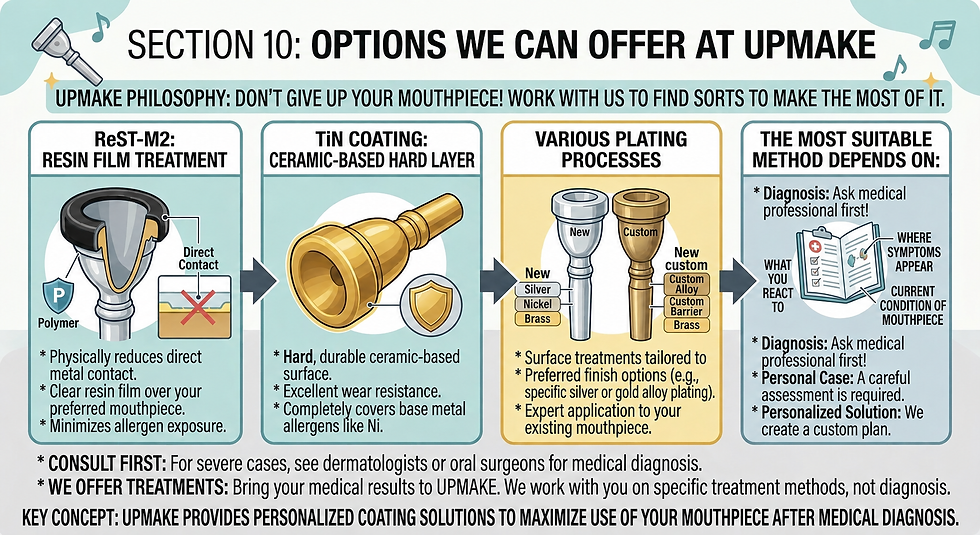
10. Options we can offer at UPMAKE
At UPMAKE, rather than simply telling you to 'give up your current mouthpiece because you have a metal allergy', we work with you to find ways to make the most of the mouthpiece you are currently using.
ReST-M2: A surface treatment that physically reduces direct contact with metal by means of a resin film
Titanium nitride (TiN) coating: A hard ceramic-based surface treatment
Various plating processes: Surface treatments tailored to the intended use and your preferred finish
However, the most suitable method depends on 'what you are reacting to', 'where the symptoms appear' and 'the current condition of your mouthpiece'. If a diagnosis is required, please seek medical advice first, and then consult us regarding the treatment method.
11. Summary: The key is to 'consider the cause and the contact separately before giving up on playing'.
Metal allergies amongst brass players are a real issue, with documented cases appearing in medical literature. However, as symptoms affecting the lips and around the mouth can also be caused by friction or irritation, it is more effective to analyse the relationship between the symptoms, your playing and the materials you come into contact with, rather than simply continuing to replace materials based on your own judgement.
Furthermore, even if an allergy is suspected, 'discarding your current mouthpiece' is not necessarily the only option. There are options for altering the contact conditions whilst maintaining the playing feel as much as possible, such as changing the material, modifying the rim, applying plating, resin coating or hard coating.
UPMAKE continues to offer this modification service with the aim of reducing, even if only slightly, the number of people who give up playing their instruments due to metal allergies. It is perfectly fine if you are still undecided. If you let us know the details of your current mouthpiece and your symptoms, we will work with you to determine the extent to which we can address the issue through modification.

References and Sources
*This article is intended to provide general information only and is not intended to serve as a diagnosis or treatment. If your symptoms persist or are severe, please consult a healthcare professional.
Comments